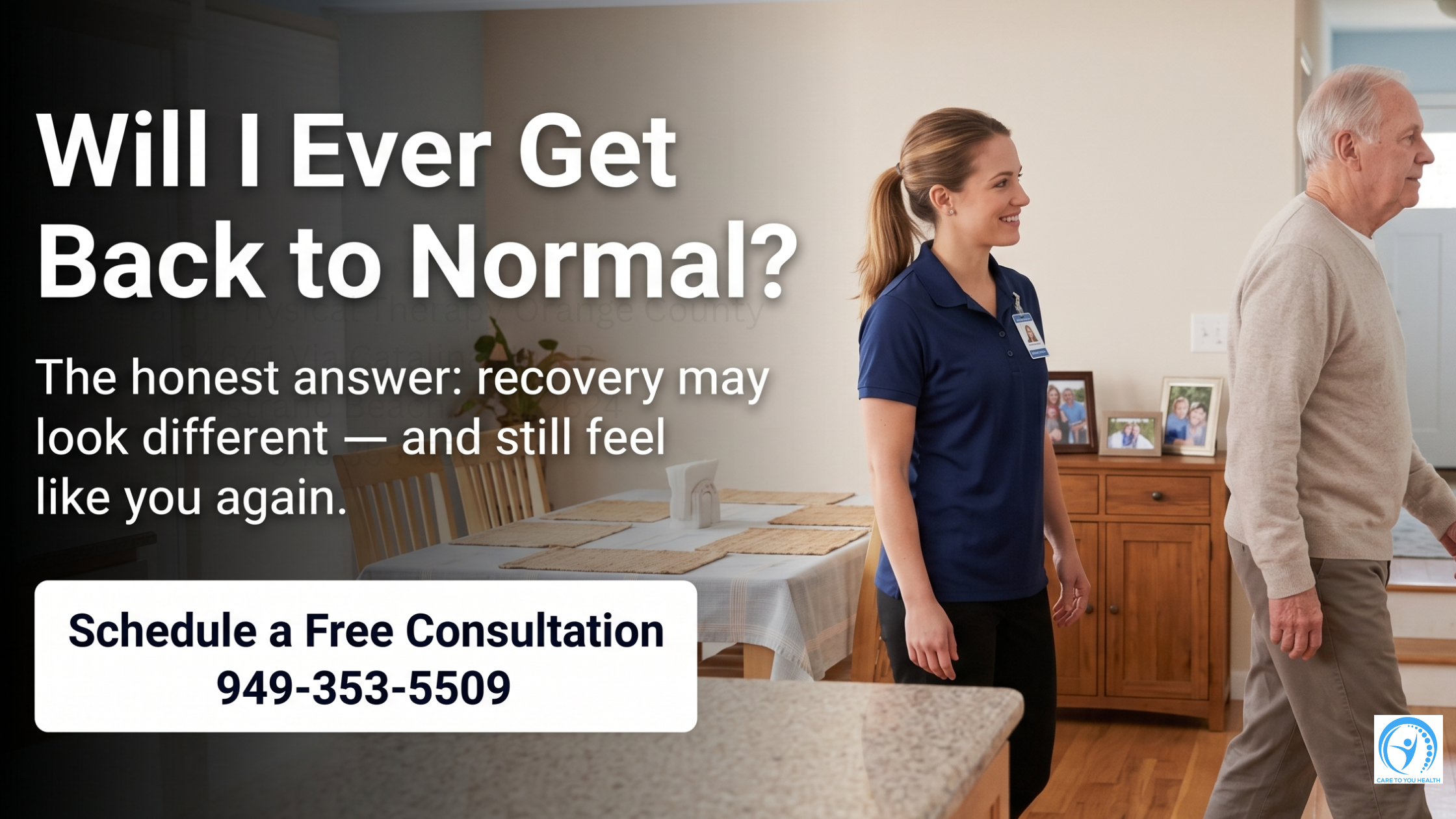
Key Takeaways: Progress You Should Celebrate
Even if they feel “small,” these signs are worth noticing—and celebrating:
✔ Moving a little more comfortably around your home.
✔ Feeling safer when you stand, turn, or use the bathroom.
✔ Having less fear of falling in familiar spaces.
✔ Completing more daily tasks without extra help.
✔ Asking for less assistance from family over time.
✔ Trusting your body a bit more this month than last.
Small wins become big transformations when you give them time—and when you have a therapist who sees them, names them, and builds on them with you.
Recovery Isn’t Only About Big Breakthroughs
Recovery isn’t measured only by major milestones.
Often, it looks like standing longer at the sink, feeling steadier in the shower, or realizing you walked to the mailbox without stopping.
Those changes are easy to overlook because they don’t feel dramatic—but they’re exactly the kind of progress that predicts long-term independence, safety, and quality of life.
“I’m Doing Everything Right… So Why Does Progress Feel So Slow?”
If you’ve ever thought this, you’re in good company.
You show up to your sessions.
You do your home exercises.
You listen to your doctor.
But when you check in with yourself, you might notice:
- You were hoping for a big change by now.
- You’re tempted to compare your recovery to someone else’s.
- You wonder, “Is therapy even working?”
Many patients expect improvement to feel obvious and fast, so when it feels gradual, they assume they’re failing—or that therapy is.
The truth: recovery isn’t failing just because it feels slow or uneven.
Why Recovery Rarely Feels Linear
Normalizing Plateaus and “Up and Down” Days
Most people secretly expect recovery to look like a smooth line upward: a little better every day.
In reality, recovery more often looks like a staircase with pauses, dips, and plateaus.
Here’s the difference between what people imagine and what usually happens:
| What People Expect | What Recovery Usually Looks Like |
| Constant, noticeable improvement | Ups and downs from week to week |
| Big breakthroughs | Small daily wins that build quietly |
| Fast, obvious results | Slow, steady change that compounds |
| One clear “finish line” | Multiple milestones along the way |
Small improvements—like needing less effort to stand, feeling steadier on a step, or having a little less pain after activity—often become the foundation for life-changing outcomes later on.
They just don’t always feel impressive in the moment.
The Milestones That Actually Matter
The Wins Your Therapist Is Watching For
It’s easy to focus on dramatic goals: walking without a device, climbing a full flight of stairs, or going back to every activity you did before.
But research and clinical experience tell us that the “smaller” milestones are often the most important for independence and quality of life.
Here’s how those wins break down:
| Physical Wins | Confidence Wins |
| Standing up from a chair with less effort | Walking without hesitating at every step |
| Needing fewer rest breaks when walking | Leaving the house for short outings again |
| Climbing a few stairs more smoothly | Trusting your body on uneven ground |
| Better balance when turning or reaching | Feeling more independent at home |
| Less pain after activity | Worrying less about falling |
Real-life examples of “small” wins that matter:
- Walking to the mailbox and back without feeling wiped out afterward.
- Cooking a simple meal while standing, instead of needing to sit for every step.
- Sleeping more comfortably because your body moves and positions better.
- Taking a shower safely with fewer fears about slipping or needing total help.
These changes may not be flashy, but they’re exactly the kind of progress that lets seniors stay independent longer.
Why Therapists Celebrate Small Wins (Even When You Don’t)
Physical therapists are trained to spot changes you might not notice or might dismiss as “nothing.”
During and between sessions, your therapist is watching for things like:
- Better posture when you stand or walk.
- Faster transitions from sitting to standing.
- Less “cheating” or compensation—using the right muscles instead of overusing others.
- Improved balance when you turn, reach, or step.
- More confidence in your movements and decisions.
Clinical guidance emphasizes that recognizing and reinforcing these “small wins” keeps patients motivated and leads to better long-term outcomes.
So when your therapist says, “Did you notice you used less effort there?” or “Last week you couldn’t do that without help,” they’re not just being nice. They’re pointing out real signs that your recovery is moving in the right direction.
What feels small to you often signals major recovery progress to them.
A Realistic Recovery Timeline: What Progress Might Look Like
Every person heals on their own schedule, but many seniors in therapy follow a pattern that looks something like this:
| Timeline | What Progress Might Look Like |
| Week 1 | Feeling a bit safer with support; learning new movements; still very aware of pain and effort. |
| Weeks 2–3 | Movements feel slightly less scary; getting in and out of chairs, bed, or the car becomes a bit smoother. |
| Weeks 4–6 | Daily tasks—like dressing, walking around the house, or climbing a few steps—start to feel somewhat easier and require fewer breaks. |
| Week 8+ | Confidence and independence grow; you’re doing more without thinking about every step and starting to feel like yourself again. |
Therapists and rehab experts agree: small, steady efforts compound into meaningful change over weeks and months.
Your path may be faster or slower, and that’s okay. Recovery is personal—not a race.
Why In-Home Therapy Makes Milestones More Meaningful
Progress You Can Feel in the Places You Actually Live
There’s a big difference between being able to do an exercise in a clinic and being able to live your life more easily at home.
Here’s how that plays out:
| Clinic Progress | Home Progress |
| Doing exercises on clinic equipment | Standing up more easily from your couch |
| Walking a measured distance in a hallway | Walking safely from your bedroom to your kitchen |
| Practicing steps on clinic stairs | Climbing your porch steps or indoor stairs |
| Practicing balance on specialized tools | Reaching into your cabinets or navigating your bathroom safely |
In-home physical therapy allows seniors to:
- Strengthen muscles and improve balance without leaving home.
- Practice movements exactly where they’ll use them—bedroom, bathroom, kitchen, hallway, front steps.
- Reduce fear of falling by pairing exercise with home safety checks and realistic practice.
Because the work happens in real life, milestones are immediately meaningful:
- “I can get off this sofa.”
- “I can shower in my bathroom with less help.”
- “I can walk through my kitchen without grabbing the counter.”
The best milestones aren’t just numbers on a chart.
They’re the moments when your home—and your life—start feeling usable again.
“I Didn’t Think It Mattered… Until I Did It Without Thinking”
“I kept waiting to feel dramatically better. I thought one day I’d wake up and just know* I was healed. My therapist kept asking me to notice little things instead: that I stood up quicker, that I needed fewer breaks, that I walked a bit farther than last week.*
One afternoon, I realized I had walked outside, watered my plants, and come back in—without thinking about every step. That was the day it clicked: the small wins had turned into something big.”
That patient later returned to gardening—a goal she thought was gone for good.
Her daughter put it this way:
“When we stopped only looking for huge changes and started celebrating small victories, suddenly we could see how far she’d come.”
FAQ: Small Progress, Plateaus, and Sticking With Therapy
Is Slow Progress Normal?
Yes. Very normal.
Rehab experts emphasize that steady, consistent effort matters more than speed, and that recovery often feels slower than it truly is.
Bodies—especially older bodies—heal and adapt over weeks and months, not days.
How Do I Know If My Therapy Is Working?
A good way to judge: track what you can do, not just how you feel on a given day.
Look for changes in:
- How easily you get in and out of chairs or bed.
- How far you can walk without needing a break.
- How steady you feel on stairs or in the bathroom.
- How much help you need from others.
Clinics encourage patients to notice improvements in everyday tasks—because those are often the earliest and most reliable signs that therapy is working.
What If I Hit a Plateau?
Plateaus are common and don’t mean you’re done improving.
When progress slows:
- Your therapist may adjust your exercises or increase/decrease intensity.
- You may need a short period of consolidation—letting your body “own” what it’s learned before pushing further.
- Sometimes progress is happening in ways you can’t feel yet (better muscle activation, safer mechanics), and outcomes catch up later.
Think of recovery as coming in waves, not a straight line.
Can Confidence Improve Before Strength?
Absolutely.
Many patients start to feel more confident moving—because they understand what’s safe and have practiced it—before they’re as strong as they want to be.
That emotional progress matters:
- When you feel safer, you move more.
- When you move more, you build strength and balance.
- When strength improves, your confidence deepens even further.
Confidence and strength feed each other.
Is In-Home Therapy Covered by Medicare?
Often, yes.
Medicare and many Medicare Advantage plans cover medically necessary in-home physical therapy for seniors with mobility limitations, fall risk, or recovery needs after injury, surgery, or illness.
At Care To You Health, coverage is verified before starting so you know exactly what to expect.
Ready to Choose Your Path to Recovery?
📋 Download Your “Choosing Your Therapy Setting” Guide
A checklist to evaluate which setting aligns with your situation, preferences, and recovery goals.
📞 Schedule a Free Consultation
Speak with Dr. Beddoe or a member of our team. We’ll discuss your specific situation, transportation circumstances, goals, and help you determine whether in-home therapy is right for you. Or we can help you find the best clinic-based option in your area if that’s a better fit.
Connect Via Phone: 949-353-5509
🏠 Request a Free In-Home Evaluation
Curious about home-based therapy? Schedule a free assessment. Meet a therapist, see your home through a rehabilitation lens, and understand what’s possible. No commitment — just clarity.
Remember
The fastest recovery comes from consistent, relevant, supported therapy — regardless of setting. Remove barriers. Choose consistency. Show up. Do the work.
Everything else is secondary.

Care To You Health: Bringing expert physical and occupational therapy to your home in South Orange County—because every step toward independence matters.
Appointments are available 7 days a week. We make it hassle-free to complete your full course of at home physical therapy by having your therapist come to you. Our therapists treat patients in your home and are available to design a schedule that is custom-fit.
Location:
On-Demand Physical Therapy Orange County
34641 Via Catalina Unit B
Capistrano Beach, CA 92624
https://maps.app.goo.gl/owNcCMCSG6H5iM87A
Connect with Us: