Key Takeaways About “Getting Back to Normal”
✔ Recovery isn’t linear. Good days and slower days are both part of the process.
✔ Progress often starts small. A little more standing, one more step, one less hand on the wall — they all add up.
✔ Confidence matters as much as strength. Feeling safe in your body is as important as what the X‑ray shows.
✔ “Normal” can evolve. Your comeback can look different — and still be beautiful.
✔ Therapy supports life, not perfection. The goal isn’t to erase every limitation; it’s to help you do what matters most, as safely and independently as possible.
✔ Staying independent is still possible. With the right plan, many seniors stay in the homes they love, moving with more confidence than they thought they’d have again.
The Honest Truth About “Normal” After Injury or Surgery
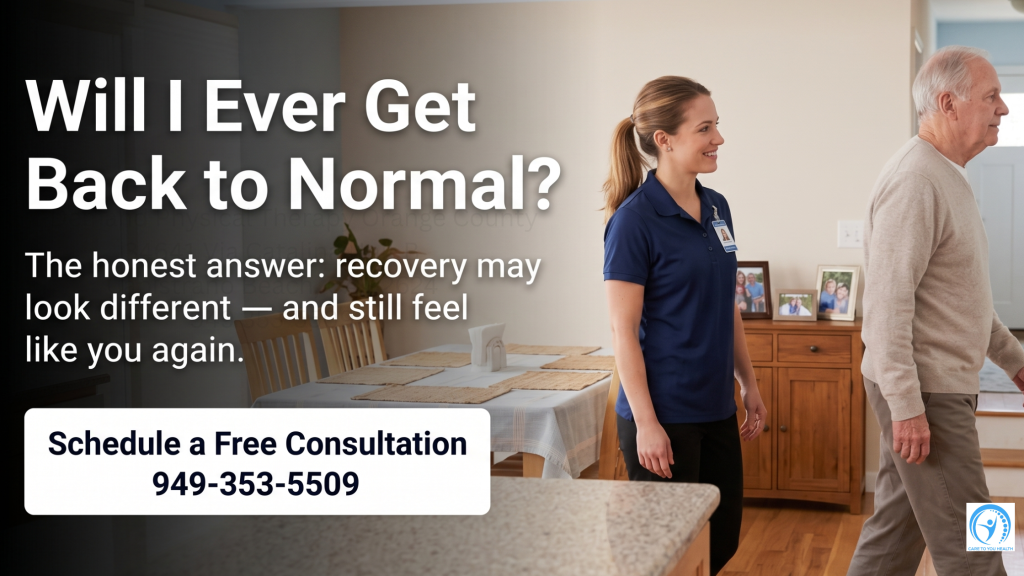
The honest answer is this: you may not get back to the exact version of normal you had before — but with the right support, you can often get back to a life that feels stronger, safer, and more in control than you imagine right now.
Recovery isn’t just about healing tissue. It’s about learning to trust your body again, returning to what matters most in your day, and finding a new version of “normal” that still feels like you.
The Question That Shows Up at 2:00 AM
This question usually doesn’t come out in the first appointment.
You nod along as your surgeon explains the procedure.
You smile and say “okay” when your therapist gives you home exercises.
You tell your family, “I’m fine, it just takes time.”
And then later — often at night, when it’s quiet — the real question shows up:
“Is this just my life now?”
“Will I always feel this stiff… this slow… this dependent?”
If you’ve thought any of the following, you’re not alone:
- “I’m doing the exercises, but I don’t feel like myself yet.”
- “Everyone says I’m doing great, but they don’t see how I struggle just to get out of a chair.”
- “What if my best days are behind me?”
That mix of fear, frustration, grief, and uncertainty is a normal part of recovery — especially after big changes like surgery, a fall, or a long hospital stay.
You’re not weak for asking these questions.
You’re human.
Redefining “Normal” in Recovery
Moving from “Going Back” to “Moving Forward”
Most people start rehab thinking:
“Normal means going back to exactly how things were.”
But bodies change over time — even without surgery or injury. And after a major event, “normal” often needs a new definition.
Here’s a healthier, more realistic way to think about it:
| Old Definition of Normal | New Definition of Recovery |
| Doing everything exactly like before | Living confidently again |
| No discomfort ever | Better daily function overall |
| Absolute independence, no help | Independence with smart support when needed |
| Doing every activity the same way | Doing what matters most, in safer ways |
Key idea: Recovery isn’t always about going back. Sometimes it’s about moving forward differently — and still feeling like yourself.
Physical therapy helps you discover what that forward-looking “normal” can be: what you can safely do, how you can adapt, and how to keep participating in the parts of life you care about.
What Physical Therapy Actually Improves
More Than Just Stronger Muscles
Physical therapy is not a magic switch. It doesn’t erase age, erase history, or make healing instant. What it does do is create the right conditions for your body and brain to move forward.
Here’s what that often looks like:
| Physical Changes | Emotional Changes |
| Strength in key muscle groups | Confidence in your ability to move |
| Better balance and coordination | Growing trust in your body |
| Improved mobility and flexibility | Reduced fear of falling or reinjury |
| Less pain or easier pain control | More hope and motivation |
| Easier daily tasks (stairs, walking, transfers) | Feeling more independent and “yourself” |
Evidence shows that after injury or surgery, physical therapy helps people regain strength, improve mobility, reduce pain, and restore independence in daily activities.
Those physical gains are powerful — but the emotional shifts (hope, confidence, and trust in your body) are what start to make life feel “normal” again.
Why Recovery Feels Slow (Even When It’s Working)
Progress Usually Happens Quietly
Most people imagine recovery as a straight line: every week a little better than the last. Reality looks more like a messy, bumpy staircase.
Here’s a more realistic timeline many patients experience:
- Week 1: Symptoms feel big.
You’re very aware of pain, stiffness, weakness. Everything feels like work. You may not notice any improvement yet — even though your body has started the healing process. - Week 3: Small changes begin.
Maybe you can stand a little longer. Maybe stairs feel slightly less terrifying. Maybe you need a bit less help with basic tasks. These changes are easy to dismiss, but they’re real. - Week 6: Daily activities feel easier.
Getting dressed, getting in and out of bed, walking to the bathroom or kitchen — these start to require less thought and effort. You still get tired, but you’re not wiped out by every little thing. - Week 8 and beyond: Identity starts to shift.
You catch yourself thinking less about the injury and more about your actual life: visits, outings, hobbies, grandkids. You’re still careful, but you’re no longer defined by what happened.
Therapists sometimes talk about a “plateau” — a phase where progress is slower or less obvious. Research suggests that while spontaneous recovery may slow, meaningful improvement is still possible for months and even years, especially when you keep practicing targeted exercises and activities.
In other words:
Just because you can’t see progress every day doesn’t mean it’s not happening.
What Success Really Looks Like in Real Life
Normal Isn’t Perfect. It’s Being Able to Do What Matters.
When you’re discouraged, it’s easy to judge success by dramatic milestones:
- “If I can’t walk like I did 20 years ago, this isn’t working.”
- “If I still feel pain sometimes, therapy must not be helping.”
But therapists — and research — define success very differently: by how well you can participate in your life.
For many patients, success looks like:
- Walking to the mailbox and back without needing to sit halfway.
- Standing in the kitchen long enough to cook a simple meal without feeling wiped out.
- Climbing the stairs to your bedroom instead of sleeping downstairs.
- Playing on the floor with a grandchild and getting back up with less fear.
- Going to church, the store, or a family gathering without worrying every second about falling.
Success isn’t measured in perfection.
It’s measured in participation.
If physical therapy helps you participate in more of what matters to you, it’s working — even if some discomfort or limitations remain.
Why In-Home Therapy Helps People Feel “Normal” Faster
Practicing Life Where Life Actually Happens
Recovering in a clinic and recovering at home can feel very different.
| Clinic-Based Recovery | Home-Based Recovery |
| Artificial setting — equipment you don’t have at home | Real-life practice in your actual rooms, stairs, and hallways |
| Travel required — energy spent just getting there | Energy stays focused on therapy, not transportation |
| Exercises may not match home setup exactly | Exercises tailored to your furniture, bathroom, kitchen, and steps |
| Limited family involvement | Family can watch, learn, and support daily |
| Great for some needs, but less carryover to home | Immediate carryover — you practice where you live |
Research and clinical experience suggest that home physical therapy helps many seniors heal faster, reduce pain, and regain independence more effectively because care is personalized to their environment and routines.
You don’t practice your life in a clinic.
You practice life where life happens — at home.
That’s why in-home therapy can make “normal” feel closer, sooner: you’re not just getting stronger; you’re learning how to safely live your real day-to-day life again.
“Will I Ever Feel Normal Again?” — A Patient Story
“I kept asking my therapist if I’d ever feel normal again. I was frustrated because I still needed help with things that used to be easy. Finally she said, ‘Let’s stop measuring what you lost and start measuring what you’re gaining.’ That changed everything.”
Together, they made a new scoreboard:
- Week 1: Needed help just to shower safely.
- Week 3: Standing long enough to make a simple breakfast.
- Week 5: Walking from the car into the grocery store with a cart for support.
- Week 8: Shopping for a week of groceries independently — with a plan for rest breaks.
“I realized I was* getting back to normal — it just looked a bit different. I could get my own groceries. I could move around my home without being scared. I could say yes to more things. We got our mom back — not the 40‑year‑old version, but the version who is here, living life.”*
— Adult daughter, Orange County
FAQ: Getting “Back to Normal” with Physical Therapy
Can Physical Therapy Really Help Me Feel Normal Again?
Often, yes — though “normal” may evolve.
Physical therapy after injury or surgery is proven to improve strength, mobility, balance, and independence, and to help many people return to daily routines with less pain and more confidence.
You may not feel exactly like you did decades ago, but you can often feel:
- More capable
- More steady
- Less limited
- More yourself
What If My Progress Feels Slow?
That doesn’t mean it isn’t happening.
Healing tissues, rebuilding strength, and retraining movement all take time. Early improvements may be tiny and easy to miss — but research shows that small, consistent efforts compound over weeks and months into meaningful change.
This is where having a therapist tracking your progress helps: they can point out gains you might overlook and adjust the plan when you hit a plateau.
Am I Too Old for Therapy to Make a Difference?
No.
Studies and clinical experience both show that older adults can build strength, improve balance, and regain function at virtually any age with the right program. Seniors regularly improve their ability to walk, climb stairs, stand from chairs, and live independently with guided therapy.
You are not “too old” to benefit. You may just need a plan tailored to your energy, medical history, and goals.
What If I’m Afraid to Move?
That’s exactly where therapy begins.
Fear of moving — especially fear of falling again — is a common and understandable response after injury or surgery. In-home therapists specialize in:
- Starting at a level that feels safe
- Providing hands-on support and clear instructions
- Gradually challenging you in ways that build confidence, not panic
You don’t have to “push through” fear alone. You work through it with someone who knows what’s safe and what’s too much.
Is In-Home Physical Therapy Covered by Medicare?
In many cases, yes.
Medicare Part B and most Medicare Advantage plans cover medically necessary in-home physical therapy when ordered by a physician — especially after hospitalization, surgery, injury, or with documented balance, mobility, or fall-risk issues.
At Care To You Health, we verify coverage before you start, so you know what to expect.
Ready to Choose Your Path to Recovery?
📋 Download Your “Choosing Your Therapy Setting” Guide
A checklist to evaluate which setting aligns with your situation, preferences, and recovery goals.
📞 Schedule a Free Consultation
Speak with Dr. Beddoe or a member of our team. We’ll discuss your specific situation, transportation circumstances, goals, and help you determine whether in-home therapy is right for you. Or we can help you find the best clinic-based option in your area if that’s a better fit.
Connect Via Phone: 949-353-5509
🏠 Request a Free In-Home Evaluation
Curious about home-based therapy? Schedule a free assessment. Meet a therapist, see your home through a rehabilitation lens, and understand what’s possible. No commitment — just clarity.
Remember
The fastest recovery comes from consistent, relevant, supported therapy — regardless of setting. Remove barriers. Choose consistency. Show up. Do the work.
Everything else is secondary.

Care To You Health: Bringing expert physical and occupational therapy to your home in South Orange County—because every step toward independence matters.
Appointments are available 7 days a week. We make it hassle-free to complete your full course of at home physical therapy by having your therapist come to you. Our therapists treat patients in your home and are available to design a schedule that is custom-fit.
Location:
On-Demand Physical Therapy Orange County
34641 Via Catalina Unit B
Capistrano Beach, CA 92624
https://maps.app.goo.gl/owNcCMCSG6H5iM87A
Connect with Us: